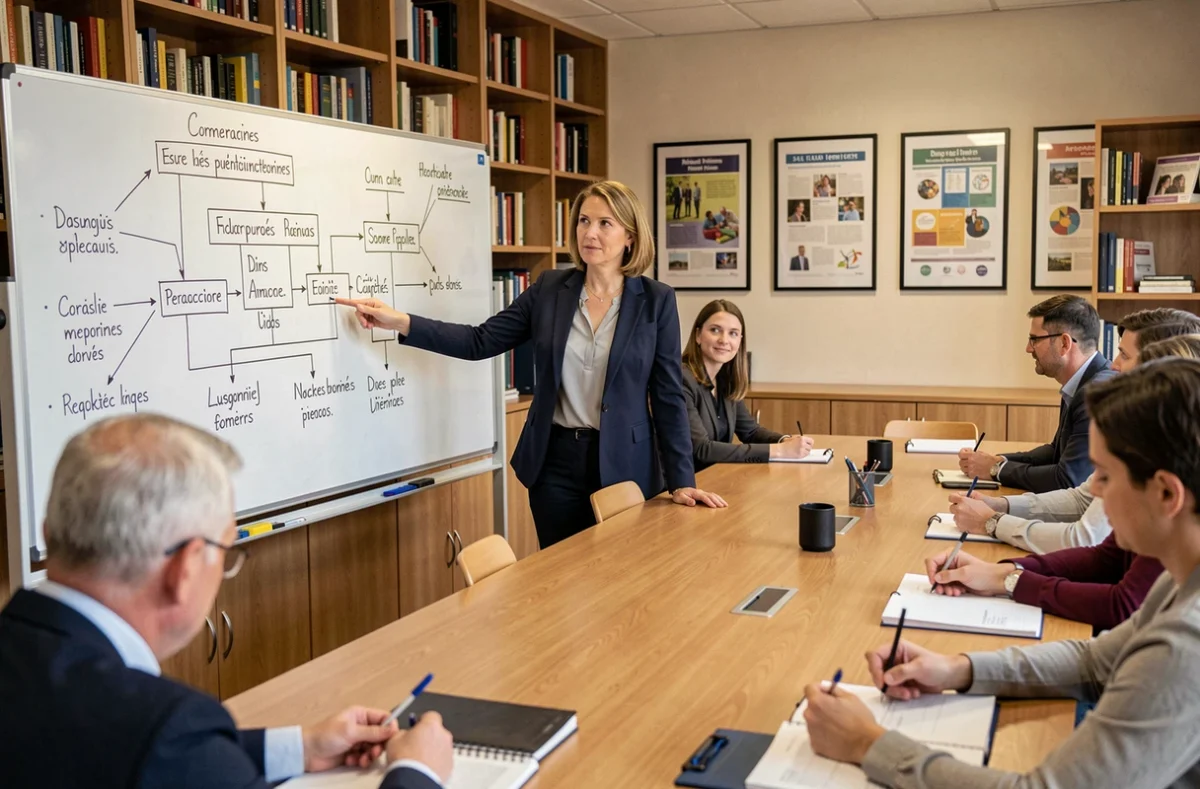
In a childcare facility, two documents consistently come up during team meetings or administrative declarations: the educational project and the pedagogical project. Their names are similar, their contents sometimes overlap, and confusion is common. Understanding what separates them allows for better organization of collective work and compliance with regulatory requirements without improvisation.
Who writes what: the question of responsibility
Before comparing the contents, let’s look at who is responsible for each document. The educational project is written by the organizer of the facility: a local authority, an association, or a daycare company. It is an institutional commitment that sets values, priorities, and general orientations.
The pedagogical project, on the other hand, is written by the on-site management team. It translates the organizer’s orientations into concrete actions, adapted to the audience being welcomed, the premises, the number of children, and the available skills.
This distribution is not just a formality. It creates a chain of coherence: the organizer sets the framework, and the on-site team applies it according to daily reality. If you are looking for a definition of the educational project on My Beautiful Job, you will find this descending logic, from the institution to the field.
Why does this distinction matter so much? Because a leisure center director who writes their pedagogical project without having read the educational project of their facility risks proposing activities disconnected from the commitments made to families and funders.
Content of the educational project and the pedagogical project: what each document really contains
You may have noticed that the term “objectives” is often used in both cases? The word is the same, but the scope differs.
The educational project sets the course
According to article R227-23 of the Social Action and Families Code, the educational project defines the objectives of the educational action and specifies the measures taken by the organizer to monitor the conditions of the facility’s operation. It takes into account the psychological and physiological needs of minors, including when it comes to minors with disabilities.
In practice, this document addresses:
- The values upheld by the organizer (secularism, inclusion, autonomy, sustainable development, for example)
- The major educational orientations, such as promoting social diversity or encouraging the discovery of nature
- The material and financial resources made available to the teams
- The modalities of information between the organizer and the on-site teams
The educational project never describes a typical day or a specific activity. It remains at a strategic level.
The pedagogical project organizes the action
The pedagogical project goes a step further. It describes how the team will implement the orientations of the educational project, with what concrete means and at what pace.
A simple example: if the educational project states “promote children’s autonomy,” the pedagogical project will specify that children aged 6 to 8 prepare their own snacks, that craft materials are freely accessible, and that quiet times are chosen, not imposed.
The pedagogical project is an operational document, anchored in a specific place and time. It changes from one stay to another, from one season to another, sometimes from one week to another in a leisure facility.
Educational project in daycare and leisure facilities: a different regulatory framework
A common pitfall is to apply the framework of collective minor facilities (leisure centers, camps) to daycares, or vice versa. Regulatory obligations do not overlap from one sector to another.
In leisure facilities without accommodation (ALSH), the declaration to the SDJES requires the submission of the educational project. The TAM application (Teleprocedure for Minor Facilities) allows it to be transmitted. The pedagogical project must be available on-site and communicated to families who request it.
In daycares, the framework is more aligned with PMI (Maternal and Child Protection) and early childhood policies. The reference documents, interlocutors, and quality criteria differ. Mechanically transposing a pedagogical project model from ALSH to a daycare ignores the specificities of each framework.
The emergency plan for daycares announced by the ministry responsible for Early Childhood on September 21, 2026, emphasizes the quality of care, the qualifications of professionals, and the attractiveness of the professions. These priorities directly influence the expected content of educational and pedagogical projects in the early childhood sector.
Making the pedagogical project a tool for continuous improvement
In many facilities, the pedagogical project is written at the beginning of the year, filed in a binder, and then pulled out during an inspection or evaluation. This approach misses its real utility.
A living pedagogical project relies on observation, analysis of gaps, and collective adjustment. The team observes what works, identifies what deviates from the established objectives, and adapts its practices. This cycle of continuous improvement transforms a simple administrative document into a lever for quality.
In practical terms, this requires a few conditions:
- Regular team exchange times dedicated to reviewing the pedagogical project
- Shared observation tools (simple grids, logbooks) to note what actually happens during activities
- A management that is willing to modify the project along the way, without waiting for the end of the period
This approach is not reserved for large facilities. A micro-daycare or a small after-school program can adopt this functioning as long as the team takes the time to confront its practices with the document it has drafted itself.
The educational project gives the direction, the pedagogical project charts the daily path. The two complement each other but do not replace one another. An establishment where these documents interact, where the team uses them to adjust its actions, offers a more coherent welcome to children and families. The real challenge is not to produce two distinct documents, but to foster the relationship between the two.