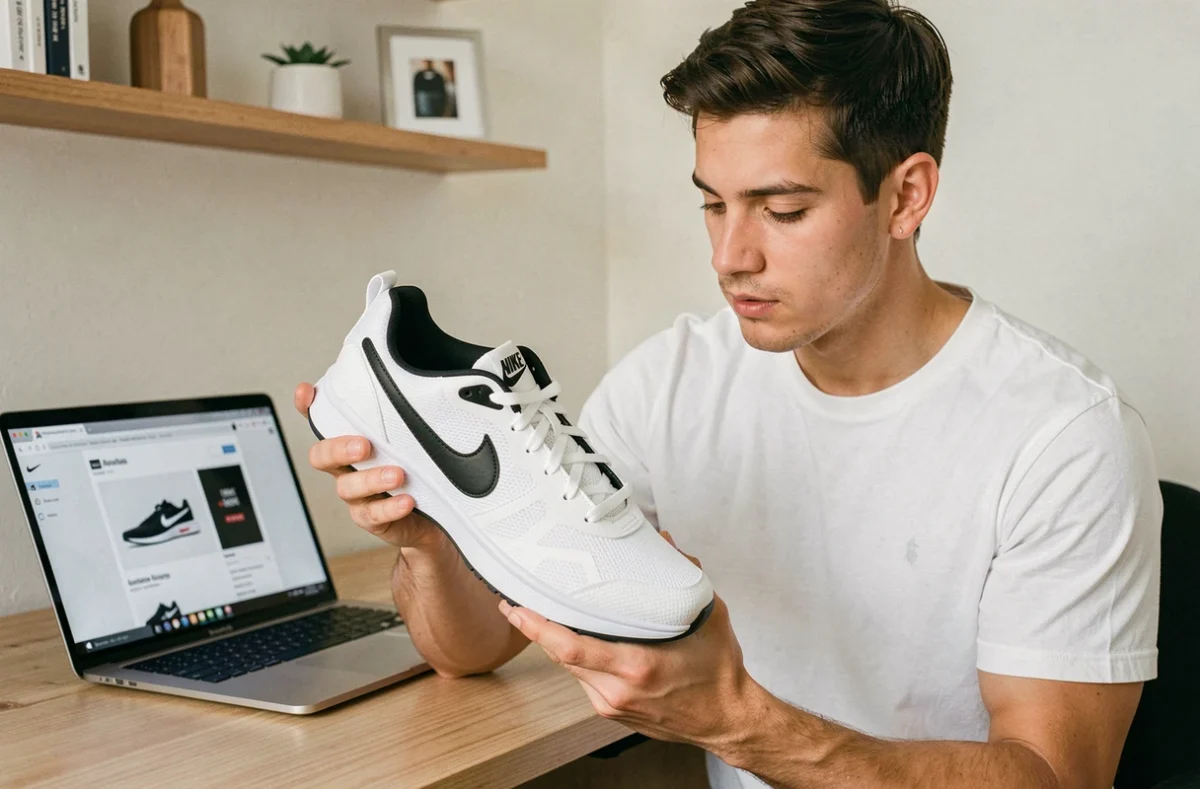
The serial number printed on the inner label of a Nike is often presented as the ultimate test to distinguish an authentic pair from a counterfeit. In reality, this code (called SKU or “style code”) is an identifier that counterfeiters can easily replicate. Checking a Nike serial number remains a useful step, but it does not guarantee authenticity on its own.
Limitations of the Nike SKU as Proof of Authenticity
The SKU is an alphanumeric code assigned by Nike to each model and colorway. It appears on the label sewn inside the shoe, on the box, and sometimes on the receipt. Its primary function is logistical: to identify a product in the catalog, not to certify its origin.
The problem is simple. A counterfeit can replicate the exact SKU of an authentic model, as this code is public. It is enough to consult any product listing online to retrieve it. A fake SKU (nonexistent in the Nike database) signals a blatant counterfeit, but a valid SKU does not prove that the pair is genuine.
The UPC/EAN code, the barcode printed under the SKU, works in the same way. You can verify it through the GEPIR (Global Electronic Party Information Registry) database to confirm that the registered manufacturer is indeed Nike. If the code points to another manufacturer or does not exist, the pair is suspicious.
A valid UPC code is not enough either: counterfeiters also copy this data. To delve deeper into the methods of cross-referencing between SKU, UPC, and physical examination, you can see the selection on Lydie Tendances that details these checks step by step.
Cross-Referencing the Nike Serial Number with the Inner Label
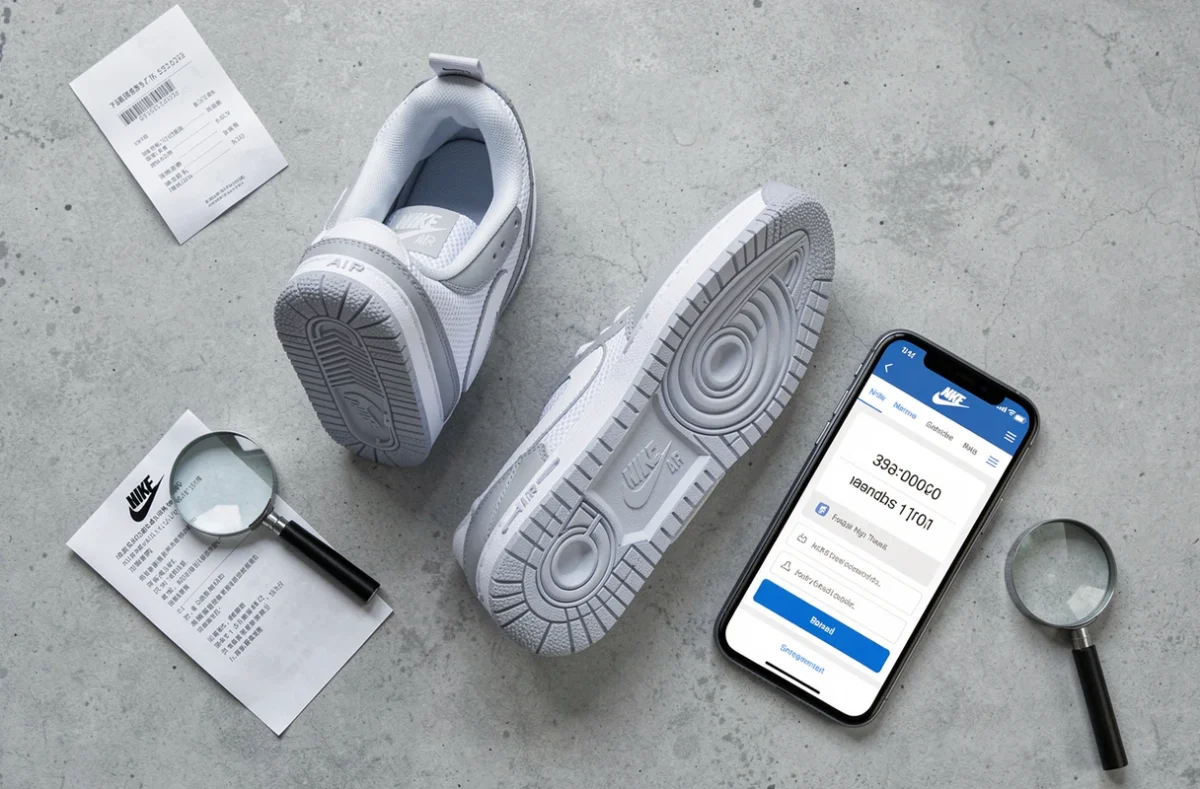
If the SKU alone does not suffice, it is the entire inner label that provides actionable clues. On an authentic Nike pair, the label features several elements printed with consistent precision.
- The font is sharp, regular, with no smudges or variations in thickness between the lines. On a counterfeit, the characters are often slightly blurry or spaced irregularly.
- The country of manufacture, size (in US, UK, EUR, and CM), and SKU are aligned according to a strict grid. A misalignment, even minimal, between the size columns is a warning signal.
- The barcode is scannable. On many fakes, the barcode is a printed image that does not return anything when scanned with an app.
- The manufacturing date is consistent with the model’s release date. A SKU for a Dunk Low released in 2024 with a manufacturing date in 2019 presents an obvious problem.
The label of a genuine Nike does not peel off easily and does not have curled edges. Counterfeits often use a sticker where Nike sews or heat-presses the label directly into the lining.
Physical Verification Beyond the Nike Serial Number
Stopping at the serial number is like only reading the cover of a book. Physical inspection points complement the verification and are more difficult for counterfeiters to falsify.
The quality of the stitching is a reliable marker. On an authentic Nike, the stitching is consistent, with no loose threads, and follows parallel lines. The stitching of the Swoosh, in particular, should be uniform on both shoes of the same pair. Asymmetrical stitching between the left and right foot is a common indicator of counterfeiting.
The sole also deserves careful examination. The pattern of the outsole must match exactly the model identified by the SKU. Counterfeiters sometimes use generic molds that produce a similar but not identical pattern.
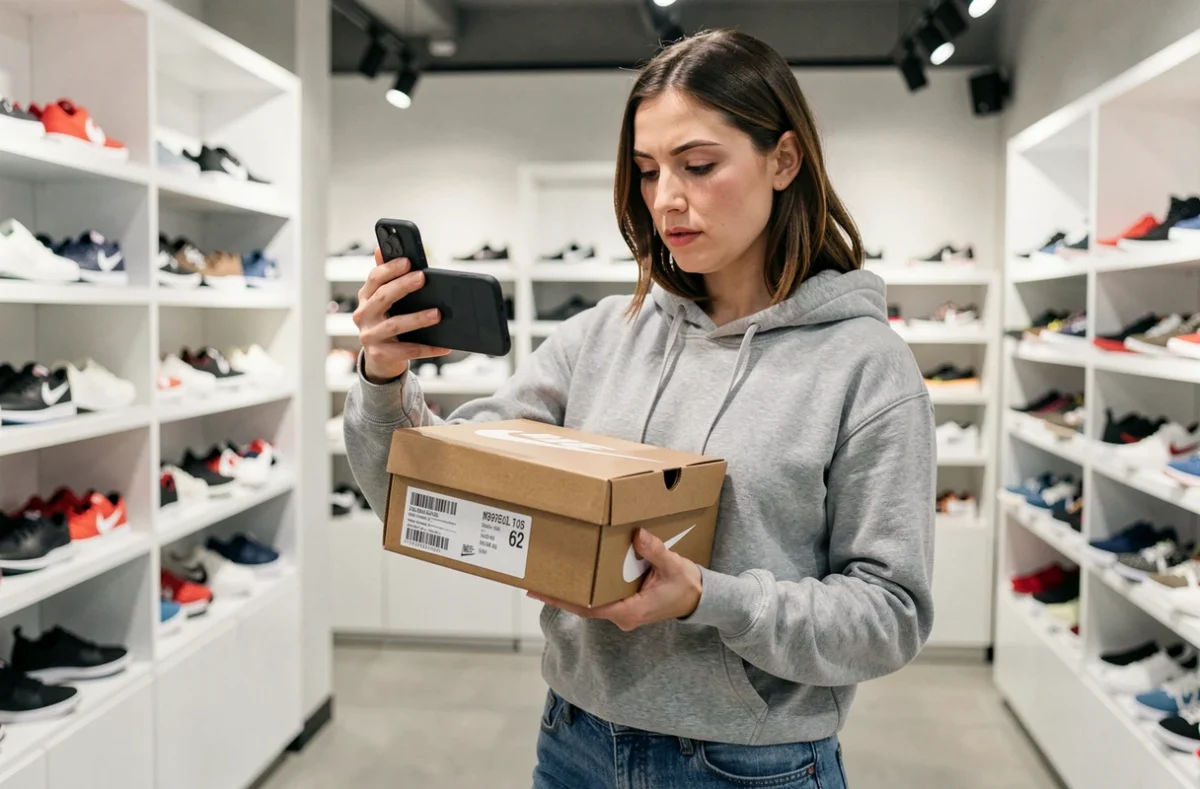
The smell, finally, remains a rudimentary but telling test. An authentic new pair emits a slight smell of industrial glue and new materials. A strong and acrid chemical smell typically indicates inferior glues and materials used in counterfeit production.
Digital Authentication: QR Code, NFC, and Data Cross-Referencing
The authentication landscape is evolving. Nike and other brands are gradually integrating NFC chips and QR codes into certain recent models. These technologies allow linking a physical pair to a unique digital record, making copying significantly more complex than just a printed number.
Recent authentication solutions combine image recognition, physical analysis, and verification of a digital record. This data cross-referencing approach renders the idea that a single element (SKU, QR code, or hologram) could suffice obsolete.
The available data does not yet indicate whether these technologies will be generalized across all Nike lines. For now, they mainly concern recent or limited editions. In the resale market, the majority of pairs in circulation do not have an NFC chip.
Market Context and Origin of Counterfeits
The scale of the phenomenon goes beyond mere anecdote. According to the Council of the European Union, 112 million counterfeit items were seized in the EU in 2024. Shoes are among the most frequently seized categories.
A often overlooked point: counterfeit production is no longer limited to Asian factories. Recent reports document that counterfeits are now being produced within the European Union itself. This puts into perspective the idea that the country of manufacture indicated on the label alone could determine the authenticity of a pair.
- A valid SKU and a “classic” country of manufacture (Vietnam, Indonesia, China) do not prove authenticity.
- A seller who refuses to provide detailed photos of the inner label and box before purchase represents a high risk.
- Resale platforms without integrated authentication services expose the buyer to greater risk.
Verifying a Nike serial number serves as a first filter. A nonexistent or inconsistent SKU eliminates the most blatant counterfeits. For carefully crafted copies, only cross-referencing the code, physical examination of the label, material quality, and, when possible, digital verification allows for a reasonable level of confidence. No isolated method replaces this combined approach.